We onboarded our first cross-team agent - Noah
It’s been a year and a half since I joined Storylane, and one of the recurring themes of problems have been:
"Is there a way to consolidate data, aggregate it in one place, and query it together?"
I wish this were one problem. A switch we could flip and suddenly have one source to query all our GTM data from.
Unfortunately, it doesn’t exist for us and I don’t think it ever will.
GTM data will always remain in silos:
1/ Sales data in a CRM
2/ CS data in the engagement platform
3/ Decisions made on calls and Slack
So we consolidated what we could, brought almost all customer data into HubSpot last year, and tried a few versions to make querying easier.
We only had one requirement, like with all experiments:
It shouldn’t suck.
On a serious note, it shouldn’t become redundant in 2 weeks from inception.
Version 1
We tried tools like Onyx and Genspark. These were GPT or Claude-like interfaces internally before connectors existed.
They worked, but were limited by how quickly integrations could be shipped back then.
Caveat. Probably much better now.
Version 2
Claude with MCPs.
This worked much better than Version 1. But the problem was session context. Retaining information across threads when multiple users wanted to ideate or collaborate was difficult.
Version 3
Locally running agents.
These worked well for a single person. But:
- no team context
- couldn’t be shared across the team
- constant context updates
- not viable for sensitive data like CRM or Slack
Version 4 ⛳ (today)
Hosted. No dependency on a local system. Lives on Slack.
Doesn’t respond to everyone. Only to users and channels we allow. Has its own memory, maintains its own customer intelligence layer, and runs smaller services in the background.
What Version 4 can do today
- Research across CRM, calls, and Slack
- Interact with selected users and channels with restrictions
- Run smaller services in the background:
- expansion and upsell signals
- reminders and repetitive workflows
- churn agent next
- Self-learning (WIP):
understands expected responses and improves over time
uses skills.md and memory.md - Memory management. This has been hard after moving to a hosted system
Biggest learnings
Guardrails and security are non-negotiable
Just like employees go through IT onboarding, agentic systems need to go through engineering. Without this, everything breaks. Security, hosting, and data safety all become issues.If it doesn’t self-learn, it falls apart
Self-learning does not mean using all data. It means learning what data to use.Not every query needs every source. The system needs to learn what to fetch.
Rollout slowly
Treat it like onboarding a new employee with high potential but no context.Inter-agent handoffs are hard
Multiple sub-agents need to pass context cleanly. This is still messy.One agent cannot do everything
You need structure:- one interaction layer (Noah)
- multiple specialized agents
Feedback loops decide everything
Long feedback loops kill systems. If loops are too abstract or too slow, it fails.
Results
Queries Noah is being used for -
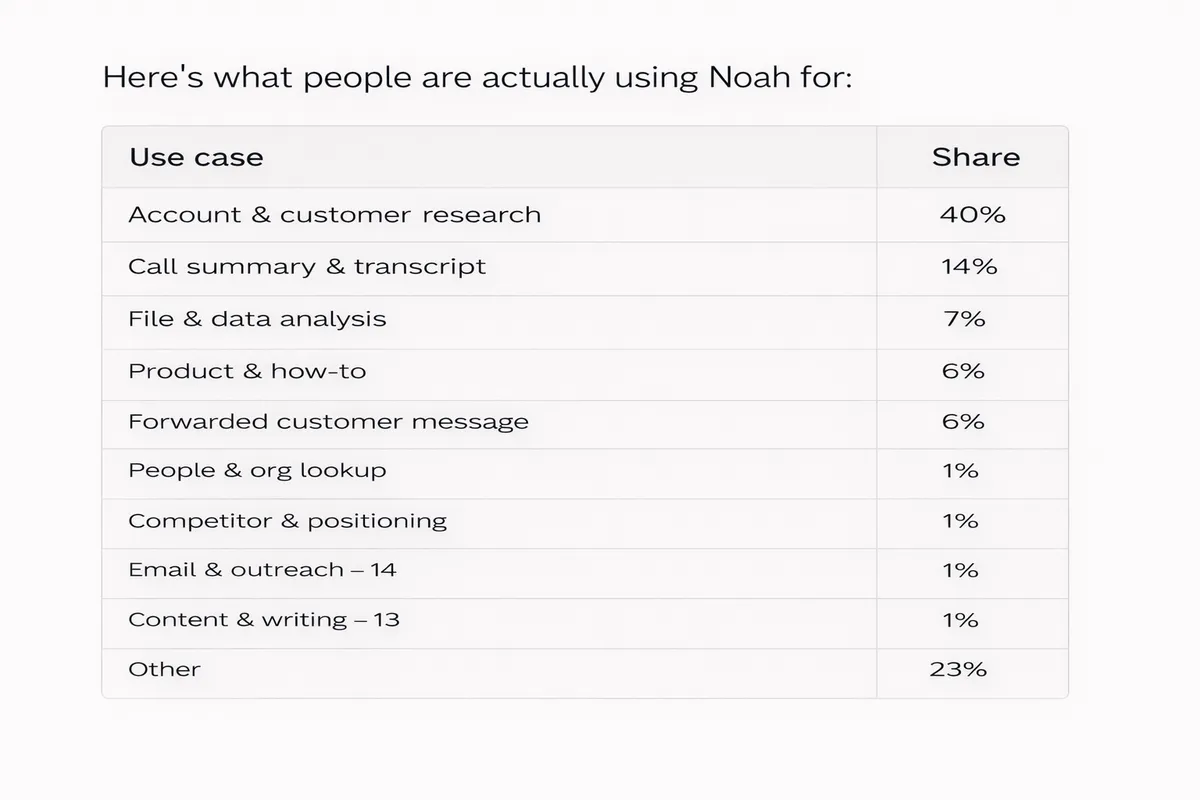
Most of this usage is coming from CS. Sales and marketing are still early.
One thing we didn’t expect
File & data analysis showing up here was surprising.
People started uploading CSVs and spreadsheets and asking Noah to:
- enrich against HubSpot
- build lists
- generate reports
We never built for this.
It just happened.
What this tells us
The dominant use case is still research.
Understanding accounts, preparing for calls, figuring out context before renewals. That’s where most of the value is coming from today.
But the more interesting part is everything around it.
Forwarded customer messages, quick summaries, file uploads, ad-hoc questions. These are not structured workflows. These are moments where people would normally switch tools or do things manually.
That’s where Noah is quietly replacing friction.
What does the future look like?
Honestly, I don’t fully know.
There is direction, but no solid roadmap. Right now, the focus is adoption.
What’s next:
Write actions
The initial focus was querying GTM data and extracting insights. Now it is about acting on it. CRM autofill, notes, identifying gaps, and spotting patterns.Specialized agents
Noah becomes the interaction layer. Everything else becomes modular.
Challenges I foresee
- Orchestrating multiple agents operating in the same plane
- Designing smaller feedback loops for specialized agents
- Role-based context. What sales needs versus what CS needs
- Agent handoffs
Example problem:
- Query comes in
- Interaction layer decides what to call
- Sub-agents fetch data
- Results conflict
If one team shows expansion and another shows decline, what gets weightage?
This is not just an AI problem.
It is a process problem.
Version 5
Honestly, I don’t know yet. It is still a black box.
But current thinking:
- Improve expansion agent
- Tighten self-learning loops
If feedback loop is more than 24 hours, it is not worth launching - Share learnings periodically
Final thought
This is still early.
But I’m hopeful.
It is already showing signs of improving productivity, and some use cases coming out of this are genuinely interesting.
It will suck.
But it will suck a little less every time.